






 Spell
 Field
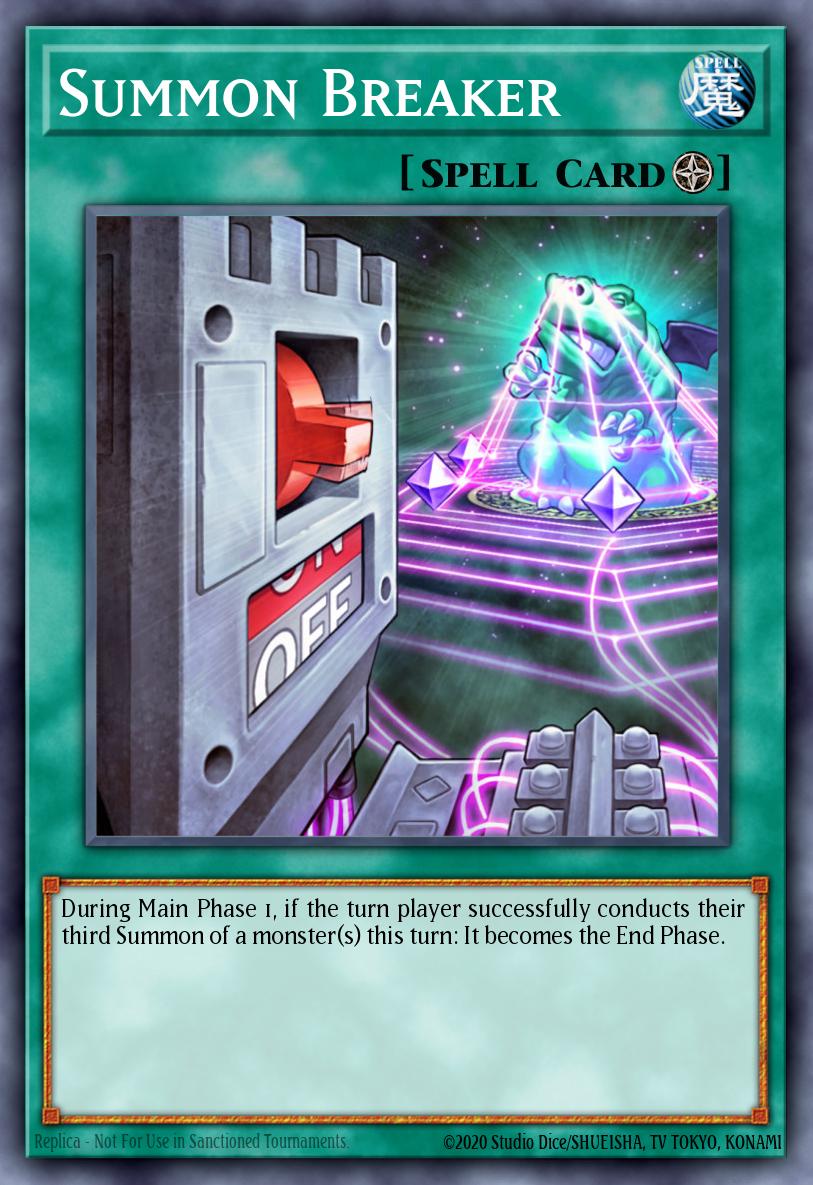
Summon Breaker
View:
5522
During Main Phase 1, if the turn player successfully conducts their third Summon of a monster(s) this turn: It becomes the End Phase.

Summon Breaker — Power Evaluation
Final Score: 49 ± 8 · Confidence: Medium
- Intrinsic: 51 · Deck: 47.4 · Meta: provisional
- Primary role: Floodgate/Control · Secondary: Board breaker
Why it scores here
Summon Breaker's only verified function is to end the turn at Main Phase 1 once the turn player completes a third Summon this turn. That is a narrow, self-restricting floodgate: it stops the player taking the third Summon as often as it stops an opponent, so effect_interaction is held to 40 and a -3 self-restriction modifier applies. No combo evidence exists, so there is no board-conversion credit, and its ATK, DEF, and view count earn nothing. The 400-of-400 deck count is suspect (a likely matching artifact), so deck synergy stays low and confidence is Medium rather than High.
Axis scores
| Axis | Score | Evidence |
|---|---|---|
| Accessibility | 60 | Spell card with 1-3 copies per deck; the evidence reports it in 400 of 400 sampled decks, which is suspicious and needs checking, so the axis is moderate (observed, with a data-quality caveat). |
| Combo & Conversion | 10 | No combo boards are recorded (total combos 0, appearances 0), and the text converts nothing into a board on its own (verified). |
| Resource Economy | 20 | The text gives no draw, search, or recursion, and the turn-ending effect costs the controller tempo when triggered (verified from text). |
| Effect & Interaction | 40 | A situational stop that triggers only on a third Summon in a single turn, applying to either player (verified from text; severity is inferred). |
| Material Utility | 5 | Not a monster and cannot be Summoned or used as material (verified from card type Spell Card). |
| Resilience & Flexibility | 55 | Persists as a continuous effect until removed, so it survives a single negation of its trigger but has no recovery route in the evidence (inferred). |
| Deck-Building Efficiency | 70 | One-copy-ish card with no garnet or lock on the rest of the deck; the only cost is its self-restriction on the user's own third Summon (verified from text plus copy distribution). |
Calculation
Weight profile: Floodgate/Control primary role, single role, no blend. Intrinsic ≈ 51, Deck ≈ 47.4, Meta = provisional. Modifiers: Self-restriction (-3). Final formula: 0.40*Intrinsic + 0.60*Deck (Deck includes the modifier)
Strengths
- Cheap single-copy effect with almost no deck-building cost
- Hard, cheap stop on multi-Summon turns for any turn player
- Broad deck spread in the sample (93 distinct archetypes)
Weaknesses
- Narrow trigger: it does nothing unless a third Summon happens in Main Phase 1
- Self-restricting, so it can hurt its own controller
- No combo evidence, so no measured board or conversion value
- Deck-inclusion figure looks like a matching artifact and needs verifying
Counters / choke points
- Removing or negating the card itself (inferred from text; not in evidence)
- Decks that rarely make a third Summon in a turn are essentially unaffected (inferred)
Best use
Floodgate/Control tech against multi-Summon turns. Decks: Swordsoul, Tenyi, Tenpai Dragon, Yang Zing, Blue-Eyes. Suggested copies: 1.
Evidence & gaps
- Verified: Description: during Main Phase 1, a third successful Summon by the turn player makes it the End Phase; Card type Spell Card, race Field, frame spell, no once-per-turn clause in the text; Formats TCG, OCG, MasterDuel, DuelLinks
- Observed: Copies per deck averaged 1.12 (max 3), with 365 decks running one copy; Partner co-occurrence: top partners appear in 29% to 69% of sampled decks; 93 distinct archetypes in the deck sample
- Inferred: Primary role is floodgate-style control rather than a starter or searcher; Negating or removing the card itself would stop its effect; Its value is highest against multi-Summon engines and lowest in decks with few Summons
- Data gaps: No combos supplied, so combo conversion is text-only inference No usage statistics (StatisticsCard); archetype inclusion is inferred from the deck sample only decks running it in the Main Deck is 400 of 400 sampled decks, which is implausible for a niche card; the CardId match may be inflated and needs verification Guide snippets do not name Summon Breaker; it appears only in co-card lists legal copies lists duellink 0 even though formats includes DuelLinks; legality needs confirmation No rulings or FAQ data to confirm the third-Summon timing in edge cases